

In November 2025, Aiello conducted an online survey targeting young Taiwanese travelers between the ages of 21 and 40. This demographic is poised to become the core consumer base for the hospitality industry over the next decade.
Understanding their needs will be crucial for hotels looking to rethink their service design and operational priorities.
Through this research, we aim to provide a roadmap for the future of hospitality services as these young travelers take center stage as primary consumers.
This analysis explores three key areas: how young travelers perceive smart accommodations, what their ideal service experience looks like, and the specific pain points they continue to face.
Want to dive into the full findings? Click here to download the complete Smart Hospitality Trends Survey Report.
Younger Generations Prioritize Smart Accommodations
Smart hospitality is no longer a foreign concept to young travelers. The survey reveals:
- Over 60% of respondents have previously used smart hotel amenities.
- 60% state that, all else being equal, they would prioritize booking a smart hotel.
For the new generation, smart services are more than just a novelty—they have become a fundamental expectation when choosing where to stay. In other words, in the future landscape of hotel competition, technology is no longer just a bonus feature; it is the price of admission.
The Ideal Smart Hotel: Always-On Service, Effortless Processes
When respondents were asked to describe their "ideal smart hotel," their answers largely fell into three categories:
36%: Fully automated, unmanned operations
21%: On-demand, 24/7 response to requests
16%: Intuitive understanding of needs to provide customized experiences
For young travelers, the true value of smart hospitality lies in efficiency and convenience. Technology is expected to step in and make services faster, more accurate, and more attuned to what guests actually want.
Which Technologies Are Most Anticipated? "AI Customer Service" Hits the Investment Sweet Spot
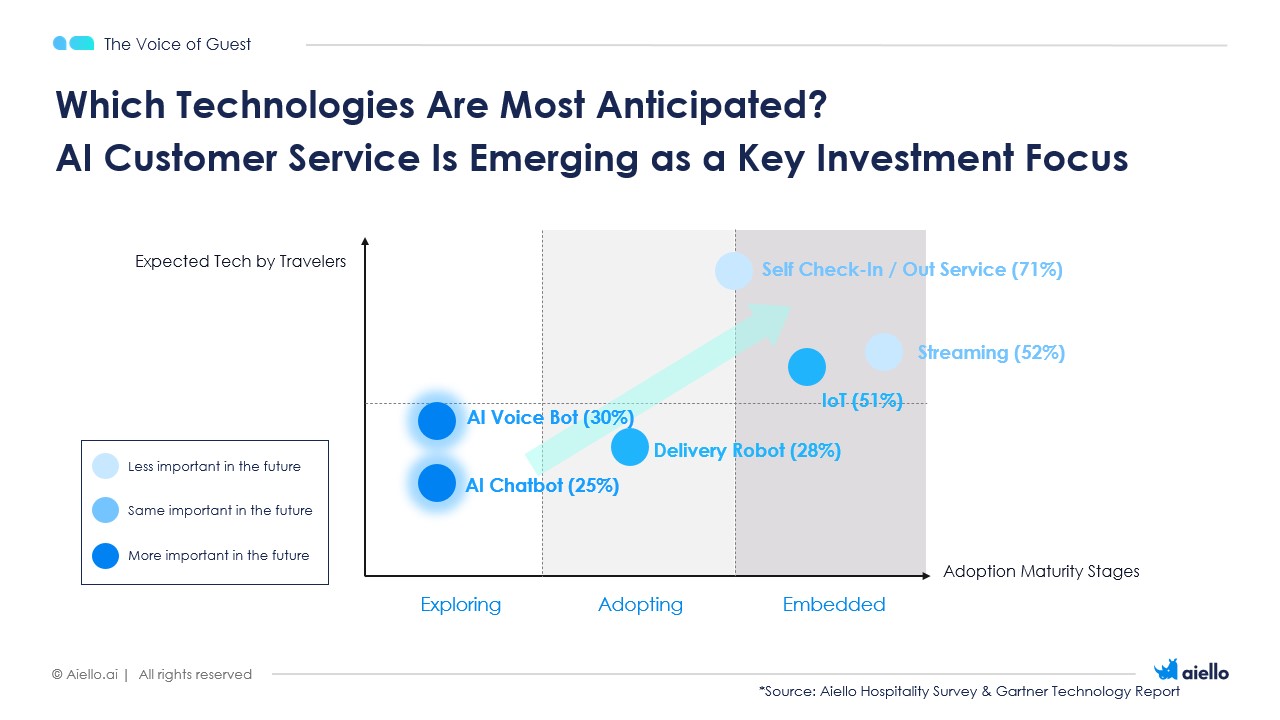
To get a clearer picture of exactly what young travelers expect from technology, we cross-referenced our survey results with the Gartner Hype Cycle for technology adoption maturity. By mapping traveler expectations (Y-axis) against technology adoption maturity (X-axis), we observed two distinct groups:
1. Mature and Widely Adopted Technologies
Self Check-in / Check-out (71%)
TV Streaming (52%)
Voice-Controlled Devices (51%)
These services have officially entered the mainstream. They are highly intuitive and familiar to young travelers.
2. Emerging Yet Highly Anticipated AI Technologies
AI Voice Customer Service (30%)
AI Text Customer Service / Chatbots (25%)
While these technologies are still in their exploration phase, they demonstrate a clear growth trajectory. Their influence and impact on the industry are expected to rise rapidly in the near future.
Looking for comprehensive insights into what young travelers expect from smart services, and where to prioritize your AI investments?
Download the report for a deep dive into traveler behavior and decision-making.
The Ultimate Demand of Young Travelers: Zero Wait, Zero Friction
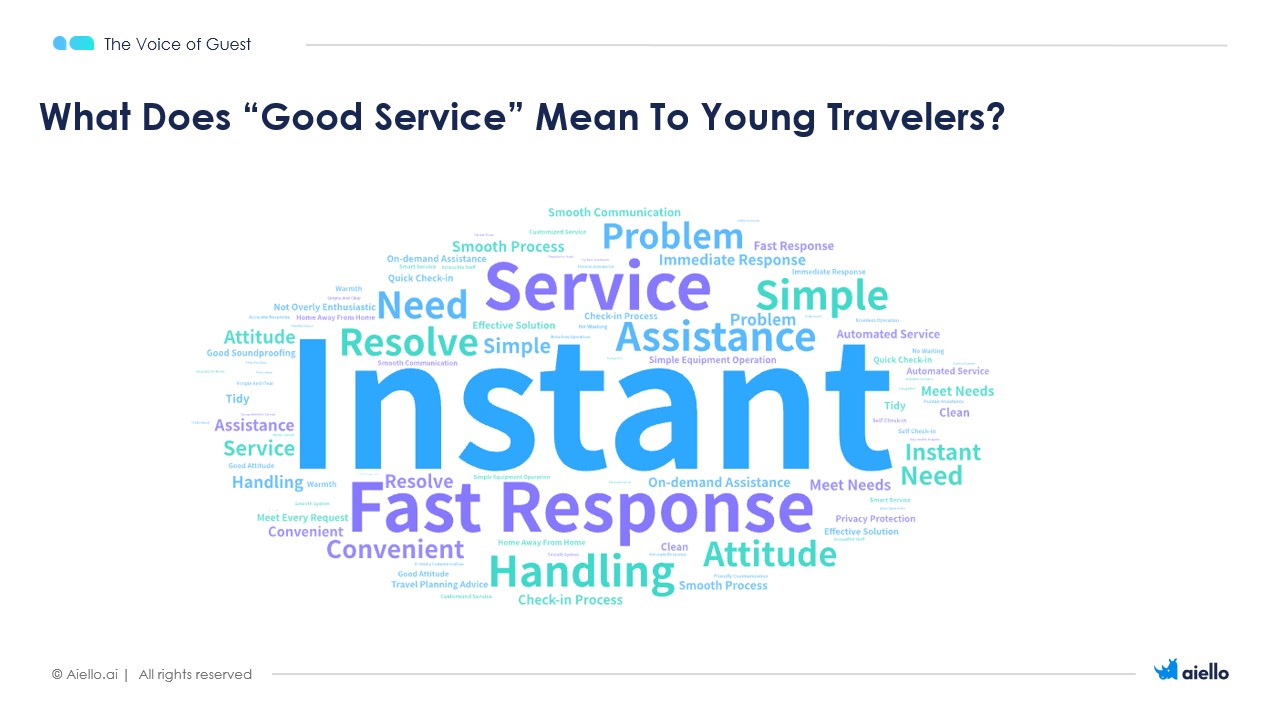
When asked the open-ended question, "What defines good service?", the most frequent keywords were "instant," "fast response," "simple," and "convenient." It is clear: young travelers expect a frictionless, zero-wait accommodation experience.
This expectation is rooted in their daily digital habits. Years of using instant messaging, food delivery apps, and online live support have set a new behavioral baseline—and they hold the hospitality industry to those exact same standards.
Three Persistent Pain Points: The Gap Between Expectation and Reality
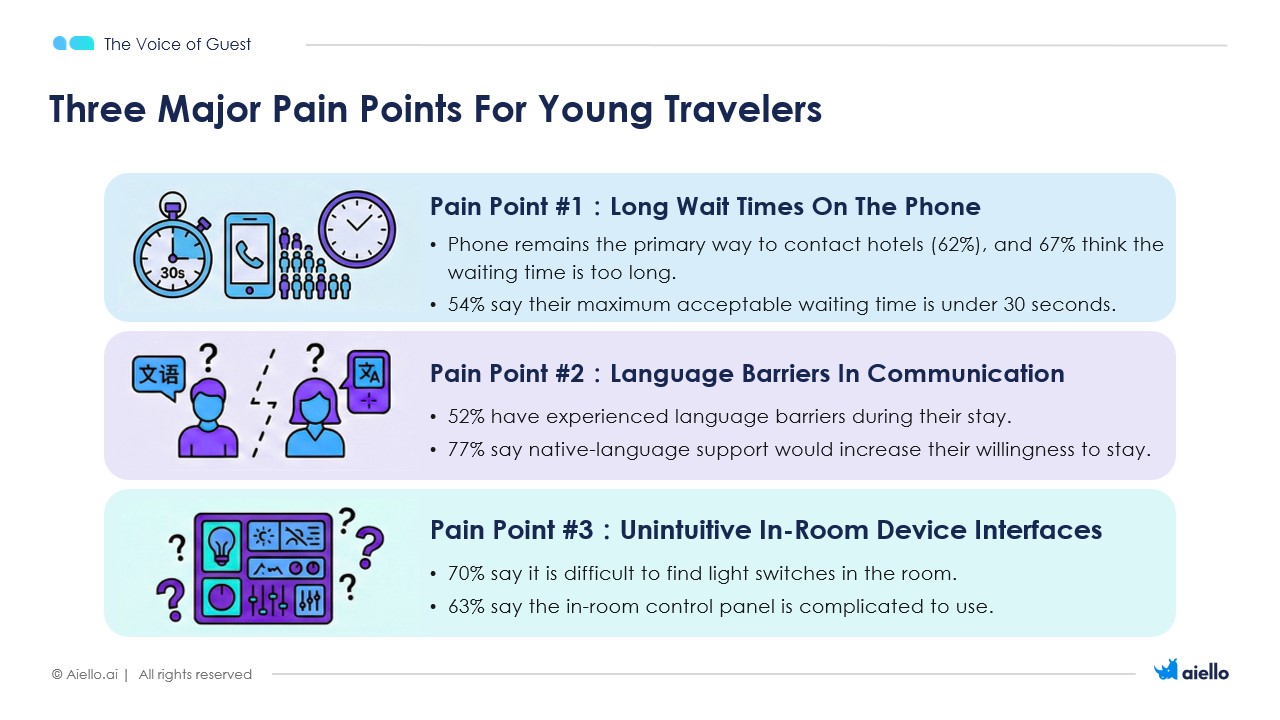
Despite the high expectations, the actual guest experience often falls short. Most respondents continue to encounter friction, primarily in three key areas:
Pain Point 1: Phone Delays and Long Wait Times
- 62% still rely on the in-room phone as their primary way to reach staff.
- Of those, 67% feel the wait time is too long
Transfers, busy signals, or unanswered calls directly clash with the efficiency young travelers crave. Notably, the survey reveals that 54% of young travelers will only wait up to 30 seconds for a response.
Once that 30-second mark is crossed, patience and satisfaction plummet. Real-time responsiveness is now a baseline requirement, not a bonus.
Pain Point 2: Language Barriers
Even among younger demographics, 52% have faced language barriers during a stay, and 77% note that native-language support would make them more likely to book. Language gaps do not merely cause friction for the guest—they also drain valuable service time for hotel staff.
Pain Point 3: Clunky In-Room Controls
70% of respondents struggle to find the right light switches or amenity controls, and 63% find room control panels overly complex. When technology requires a learning curve, it transforms from a helpful upgrade into a frustrating obstacle.
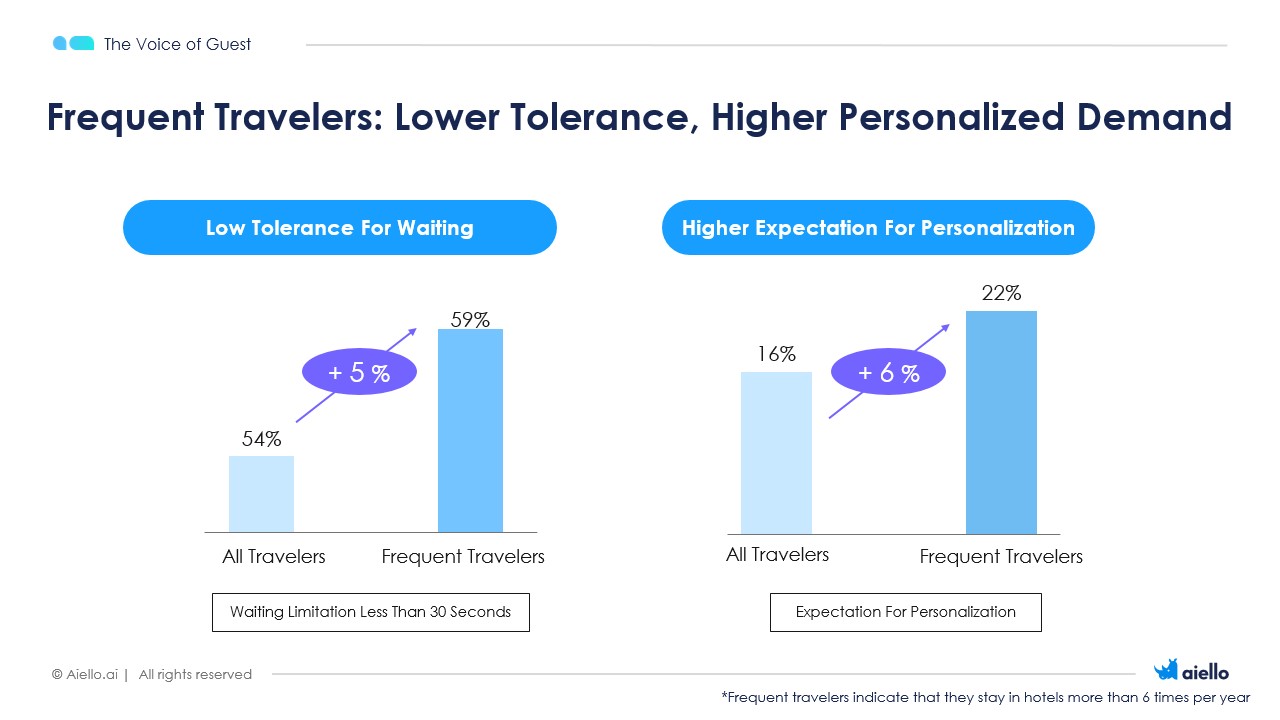
Frequent Travelers: Higher Standards for Responsiveness and Personalization
- Lower tolerance for wait times
- Greater demand for personalized service
Given the outsized impact these guests have on hotel revenue and online reputation, their preferences are poised to set the new benchmark for the entire hospitality industry.
Key Takeaways: What Young Travelers Truly Expect from Smart Hospitality
Synthesizing the survey results reveals three universal demands among young travelers:
- Instant, real-time service responses.
- Intuitive, frictionless user interfaces.
- Context-aware, personalized experiences.
These are no longer mere preferences. Forged by years of seamless digital interactions, these expectations have established a new baseline by which all future hotel stays will be judged.
Aiello’s Perspective: Young Travelers Dictate the Next Era of Hospitality
Download the complete Smart Hospitality Trends Survey Report for critical insights into traveler behavior and the future of industry talent.
The data reveals a fundamental truth: the success of a smart hotel is not measured by the sheer volume of technology implemented, but by its ability to resolve actual guest friction. For the younger generation, efficiency, intuitive design, and personalized service have shifted from premium perks to standard expectations.
Technology only translates into a memorable, value-driven experience when operational workflows are entirely redesigned around the guest's needs. That is the true next step for smart hospitality.
Ready to turn these insights into an actionable AI service strategy? [Contact Us] to map out your hotel’s smart transformation today.